

Hugh Hayden’s American Vernacular: Reshaping How We See with More-than-humans

Rebellion is embedded in his work; more-than-humans rage against capitalism and their existence for human consumption. This rebellion makes visible forgotten histories and polysemic narratives. The material in Hayden’s work breaks free to exist beyond the human gaze.

Hugh Hayden’s American Vernacular at The Frye Art Museum in Seattle (June 28 to September 28, 2025) took me to familiar places while subverting my expectations. I was open to this unexpected journey through “The Kitchen”, “The Gym”, “The Church”, “The Nursery”, “The Closet”, and “The Lawn”, having watched Hayden’s “An adaptation of the American Dream” on the Louisiana Channel’s Youtube. I enjoy Hayden’s ability to make visible the hidden curriculums for Black people living, achieving, and existing within the American Dream. In American Vernacular, Hayden brings to light those systems constraining Black freedom, as well as the tools by which we resist and contend. In Hayden’s work, Black imagination does not have to replicate the colonial perception of more-than-humans. Instead, American Vernacular was an imaginative environmental articulation about more-than-humans and Black people existing, resisting, and persisting on an interconnected plain.
I first encountered Hayden’s work in “An adaptation of the American Dream” on Louisiana Channel’s YouTube in 2024. In the segment, Hayden expressed a desire to look at the source material of everyday items as a link to the natural world. Rebellion is embedded in his work; more-than-humans rage against capitalism and their existence for human consumption. This rebellion makes visible forgotten histories and polysemic narratives. The material in Hayden’s work breaks free to exist beyond the human gaze. “Most people don’t even think of a pencil anymore as a piece of wood or as an extension of a tree,” Hayden said in the segment. Hayden’s work brings in the more-than-human perspective while simultaneously contending with the cultural implications of more-than-humans as material.
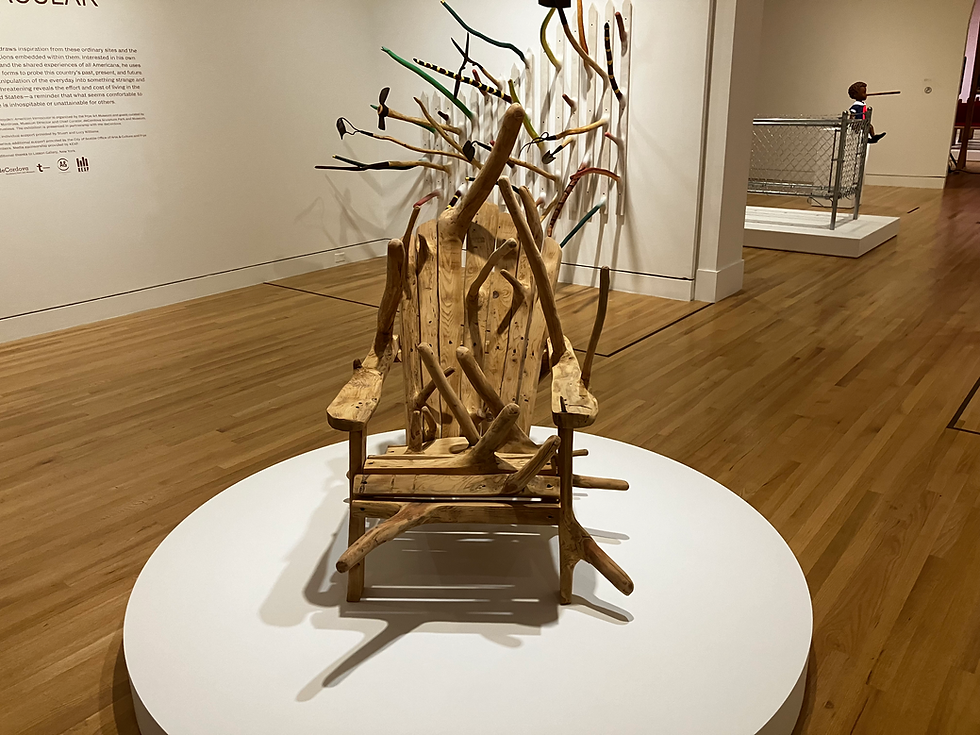
A home’s lawn is about perception and a space for leisure and comfort; in Hayden’s American Vernacular, “The Lawn”, has a wooden lawn chair not suitable for lounging. Though a lawn is often green and filled with plants, foliage is more of an aesthetic choice than supporting an ecological ecosystem. As a child on the West side of Chicago, we knew not to step on Mr. Martin’s manicured lawn in his front yard, because maintaining it was a source of pride and an expression of his American Dream. The chair in “The Lawn” called “The Jones and other borrowed ideas” (2017), is made from fallen hemlock. Long, erect wooden pieces protrude outward where back support and seating would normally be. The chair looks possessed by a wooden spirit, harkening back to the wood’s past lives. The chair’s history as a tree refuses to be ignored. This uncovering and remembrance is complicated within the landscape of Black memory because of lynching, and “The Jones and other borrowed ideas” insist on reckoning with these past lives that shape American landscapes.
Further on “The Lawn”, I see the spirit of refusal in “Eden” (2025), a wooden white fence with a mixture of garden tools, a snake assortment, and phallic objects sticking out of fence panels. “Eden” is polylithic. The fence evokes a sort of boobie trap atmosphere, like lawns warding off Zombies in The Walking Dead. Similar to the chair, the more-than-human resists the white-picket fence so emblematic in the American Dream. To some, the serpents rising out of the fence evoke an evil persona due to the Biblical story of the Garden of Eden, but snakes are a natural part of the ecosystem that had or have a place on the lawn. Within the American Vernacular, the serpent too contends with the violent systems that have made the American Dream possible: the collection of items poking from the fence signal the Transatlantic slave trade and the plantation economy, where enslaved Black people toiled the land to build that American Dream. The garden tools are also weapons of mass destruction, getting rid of native plants, or “weeds”, to make way for manicured lawns that are not as beneficial to the ecosystem as native plants.
In the Louisiana Channel segment, Hayden said that his love for gardening and living at the edge of a forest at an early age has influenced his work. This examination of the natural world in his work provides an alternative relationality for humans with more-than-humans. On “The Lawn” more-than-humans are portals to cultural histories and past lives of materials that go beyond their human consumption and gaze. The garden tools within “Eden” also offer an ancestral gateway for remembering Black ways of knowing. I think about my own Grandmother’s garden and her resistance within the concrete on the west side of Chicago. She was a former sharecropper from Mississippi who gardened even as she achieved the American Dream through homeownership.
Just beyond “The Lawn”, in “The Nursery”, a chain-link fence articulates hostile architecture that is at odds with nurturing Black lives. A chain-link fence could be a gate found at Grandma’s house, yet in “Start ‘Em Young,” (2023) the chain-link is in the shape of a baby’s crib. The crib has no mattress. The headboard of the crib is barbed-wire, which also surrounds the railings of the crib. The crib is uncomfortable and inescapable. A baby wanting to escape this inhospitable refuge would be further harmed. The chain-link crib evokes the United States carceral system, pain, the lack of care, and society’s imprisonment of Black bodies disproportionately. While the chain-link fence signals imprisonment, it can also serve as protection. The polysemic qualities of the chain-link fence as protection and keeping out like Grandma’s fence and imprisonment, shows the nuances when living within an American vernacular.

“Nocecchio” (2024), a wood sculpture based on Pinocchio, is viewable just beyond the chain-link crib in “The Nursery”. Hayden replaces “pino” meaning pine with “noce” meaning walnut in Italian to signal the type of tree the sculpture’s wood comes from. Pinocchio is a fictional character that evokes innocence and boyhood; yet, Pinocchio's refrain of wanting to be a “real boy” takes on new meaning in “The Nursery”. When Pinocchio is a Black boy (or Nocecchio), his refrain joins the chorus of “He was only 12” and “I can’t breathe.” When the boy wanting to be real is Black in America, he lives within a society that does not treat him like a real boy, child, or human. The assertion that Black boys are real boys makes Nocecchio’s nose grow because this insistence is in conflict with the Black boyhood narratives shaping American vernacular.
“The Church” did not say “Amen” in Hayden’s American Vernacular. Instead, Erykah Badu’s “On and On” played as I walked toward it from “The Nursery”. In this portion of the exhibit, I saw wooden church pews with red bristles sticking up from them. The church pews in Hayden’s “Good Hair I” are familiar to me as a great granddaughter of a pastor, but nothing in this space was as expected. For one, the music was secular. I was also disoriented by the flashing red and blue lights from “Hypnotism,” (2017-2020), which sits in front of the pews where a pulpit would normally be in a church. The American Flag is most visible in “Hypnotism”, but the images flashed and changed, while Badu’s “On and On” played on speakers. I could not make out the other images with my own eyes, but “Hypnotism” contained a cross, smiley face, heart, and a dollar sign, according to exhibit descriptions on the Frye Art Museum’s Instagram. The flashing lights created an effect like a visible holy ghost floating through the air, overtaking my senses, and the only recourse was to fall out or exit and come back in short stints. Again, the pews were not a place for refuge because of the bristles, and even if they were, the atmosphere would have made sitting there unbearable. The nylon bristles allude to a hair brush and the concept of good hair that says hair closer to European standards is better than our natural hair. The bristles are also a metaphor for scrubbing away the narratives about Blackness like “good hair” through sacred intervention. “Ultimately, “Good Hair I” shows both the disturbance of the sacred and its power for Black communities. In American Vernacular, The Black Church is a safe haven, and a Christian organization that has roots in colonization. In “The Church”, I think about Audre Lorde’s concept The Master’s Tools.

In the “Gym” the American Dream is sought through sports, like explored in the 1994 documentary, Hoop Dreams. The classic film features Black youth and the belief that basketball was a way to a better life. Many items in “The Gym” stand out. I am drawn to “The Rapunzel” (2024) for its commentary on this route to escape and achieve; it contains a painted white PVC backboard with and a net that extends to the floor swirling like Rapunzel’s locks of hair. This net is synthetic hair extensions, braided like singer 90s Brandy and Cleo from Set It Off, communicating resistance and a roadmap out of the fairytale and toward an otherwise. I walked toward “The Closet” that is near “The Gym”, and they felt connected. In this closet is “Daphne” (2022), Louboutin So Kate Stilettos made out of cherry bark and Plywood (2024), rib cage sculptures made from a mix of wood and stainless steel. I saw “Real Tree” (2023), a two-piece, Zegna suit made out of cherry bark, cherry wood, and steel. The collection of items in “The Closet” are a conversation about the finer things in life that one might strive for within the American Dream. Perhaps these are the finer things driving some hoop dreams. “The Closet” looks at the items beyond materialism and the ways that these items can articulate aspiration and belonging.

“The Kitchen” contains items that I’d expect to find in a Black household but Hayden’s pieces reflect a sort of mashed up rendering: a table, African mask art, musical instruments, and cast iron skittles. African Mask art and cast iron skillets are apart of Black culture, but “Andormeda” combines the two.“Andormeda” (2023) and “Bottoms Up” (2023) are seasoned cast iron and bronze pots with African mask art. In “Andormeda” and “Bottoms Up” Hayden uses sand-casting, pouring liquid metal into a cavity he molds from sand; this results in certain details being smoothed over. The product through sand-casting renders a new, less replicated version of the mask that symbolizes the Black experience of melding of cultures–past and present. This collision is a bridge between two cultures that reflect the Black experience pre and post transatlantic slavery. In “Form I-130” (2025), an IKEA dining set, with brown fiber bristles, I see the hostile architecture similar to the church pews and the lawn chair. Form I-130, is a form that United States citizens can use to request family members to come for a chance at a Green Card. Perhaps the table embodies this interruption of the sacred–the family and the systems like ICE that make it hard to sit at the dinner table with family.

My final stop in American Vernacular is “Harlem” (2024), 24 karat gold plated cast iron, copper and brass instruments hanging on a stainless steel rack. I am happy to end with the jazz of it all–the music that emerges like diamonds in “The Kitchen”. In this place, I thought about hearing a jazz ensemble, as evoked by the faces mixed in with the saxophone, trombone, and trumpets on the gold pots. Maybe if I chose to click the pots together, they could make jazz, or maybe jazz could be making memories in the kitchen with food. And, I imagine that the mix of feeling, improvising, and dueling realities is what the American Vernacular is. Perhaps my biggest takeaway from the exhibit is the ability and need to see beyond the constraints; this is facilitated through Hayden's reshaping of our perceptions of the familiar material in American Vernacular and beyond the material world.


Comments